
Atomic Astrophysics group
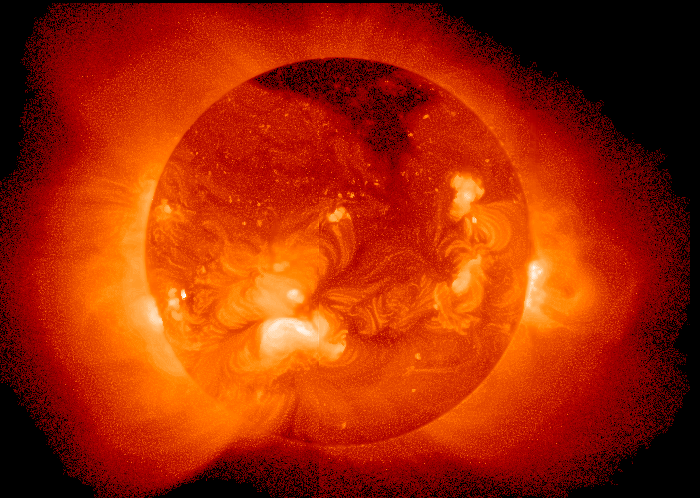 Atomic physics plays a key role in astrophysics as astronomers' only information about a particular object comes through the light that it emits, and this light arises through atomic transitions. The two major topics tackled by our group are thus:
- Performing atomic physics calculations that will be useful to astronomers. This group has played a key role in developing and maintaining CHIANTI , a Database for Astrophysical Emission Line Spectroscopy.
- Using atomic data to interpret astronomical observations. The main astronomical body that we study is the Sun and, in particular, the hot atmosphere of the Sun called the corona. The best parts of the electromagnetic spectrum to study the corona are the extreme ultraviolet (EUV) and X-rays.
The EUV is an excellent region to perform spectroscopy and a lot of effort has been devoted in analysing and interpreting solar spectra from Extreme-ultraviolet Imaging Spectrometer (EIS) aboard the Japanese/UK/USA mission HINODE formerly known as SOLAR-B.
The group is also involved in the Iron Project and the UK APAP Network . The goal of this project is to compute, on a large scale, electron excitation cross sections and rates of astrophysical and technological importance, using the most reliable procedures currently available.
- ©DAMTP, Centre of Mathematical Sciences, Wilberforce Road, Cambridge CB3 0WA
Page last updated: 11 Jan 2016 by Giulio Del Zanna - Privacy
- Accessibility